Abstract
This page explores the various methods used to solve first-order ordinary differential equations (ODEs) that model the temperature change of a solar panel. We investigate analytical solutions, numerical methods, and machine learning approaches to understand the dynamics of the system. Currently, we have evaluated the exact solution of the linear ODE modeling temperature change, alongside numerical methods such as Euler's method and the Improved Euler's method (Heun's method).
Mathematical Modeling
The temperature dynamics of the solar panel are governed by the balance of solar absorption, convective cooling, and (in the nonlinear case) radiative heat loss.
1. Linear Case: Convection Only
The linear ordinary differential equation (ODE) for temperature $T$ over time $t$ is expressed as:
$$\frac{dT}{dt} = \frac{1}{mc_p} [ (\alpha - \eta)GA - h_{conv}A(T - T_{amb}) ]$$Where the exact solution is given by:
$$T(t) = T_{ss} + (T_0 - T_{ss})e^{-(t - t_0) / \tau}$$- Steady-state temperature ($T_{ss}$): $T_{amb} + \frac{(\alpha - \eta)G}{h_{conv}}$
- Thermal time constant ($\tau$): $\frac{mc_p}{h_{conv}A}$
2. Nonlinear Case: Convection + Radiation
Adding the Stefan-Boltzmann law for radiation introduces a $T^4$ term, making the ODE nonlinear
$$\frac{dT}{dt} = \frac{1}{mc_p} [ (\alpha - \eta)GA - h_{conv}A(T - T_{amb}) - \epsilon\sigma A(T^4 - T_{sky}^4) ]$$Numerical Methods & Results
We compared the Forward Euler method (first-order) against the Improved Euler / Heun’s Method (second-order).
Effect of Step Size ($h$) on Convergence
Numerical accuracy is highly dependent on the time step ($h$). As seen in our analysis, reducing the step size from $h=100s$ (37 points) to $h=10s$ (361 points) significantly reduces the absolute error in the linear model.
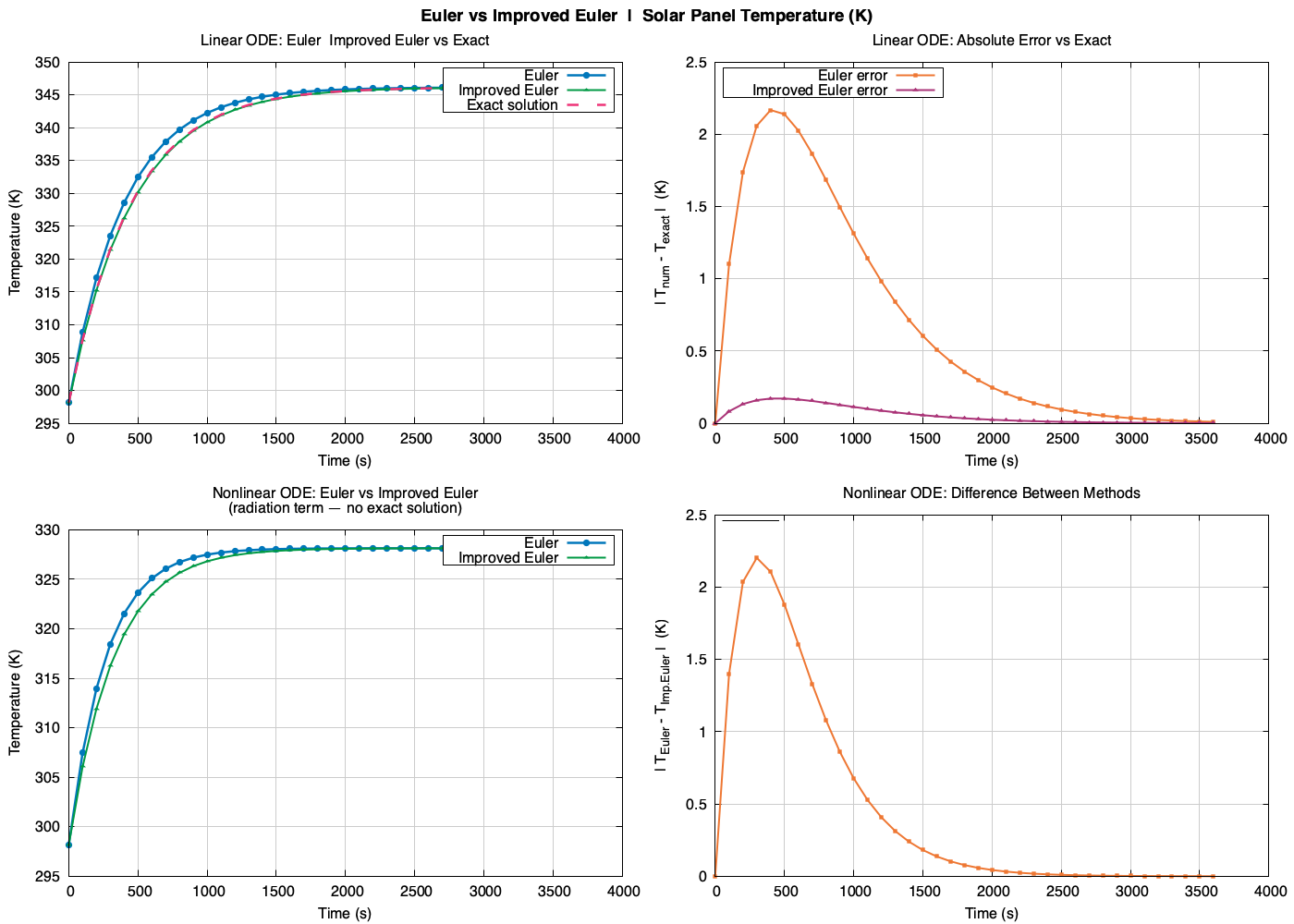
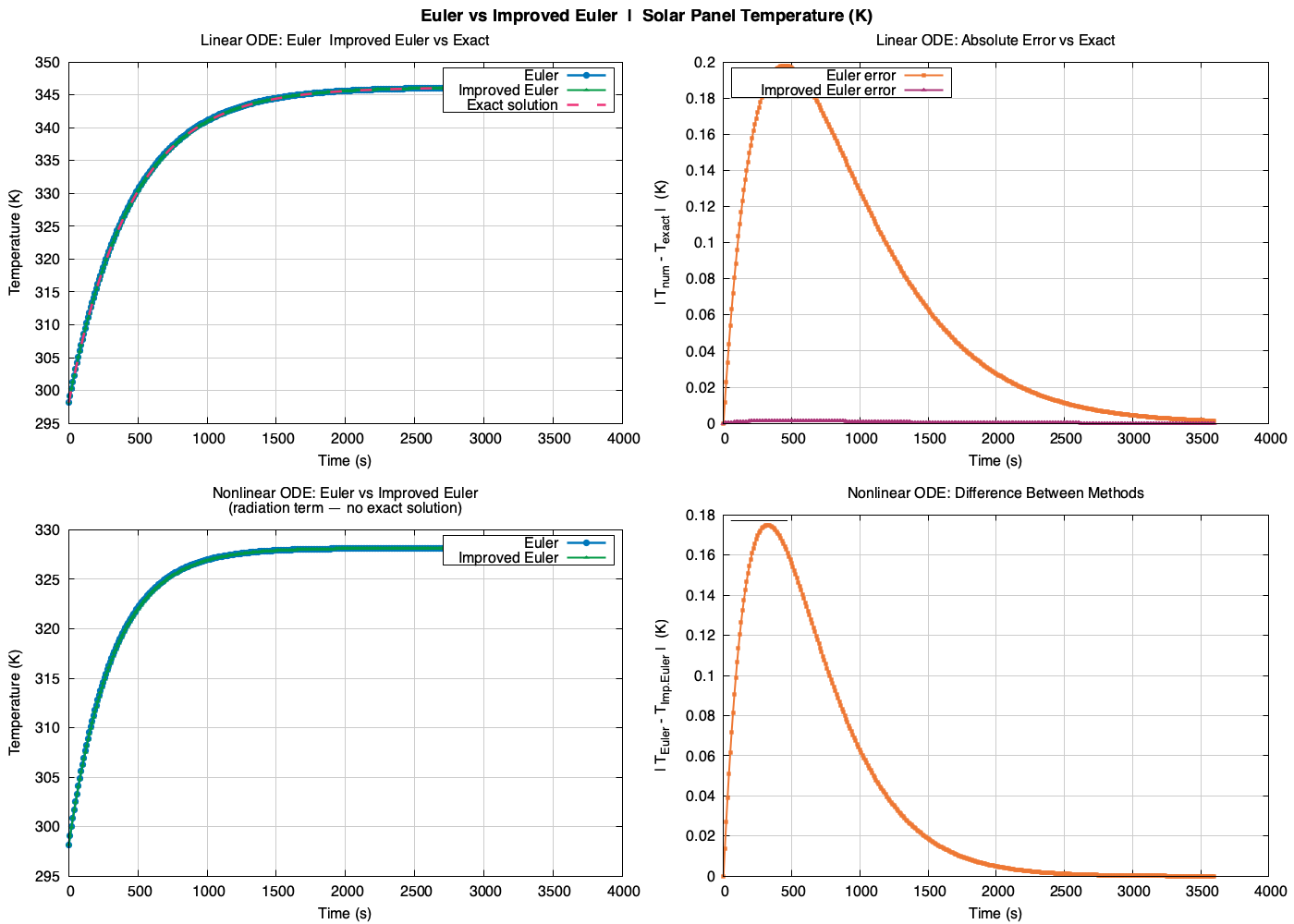
Notice that the Improved Euler method (Heun's) maintains a much lower error profile even at larger step sizes compared to the standard Euler method.
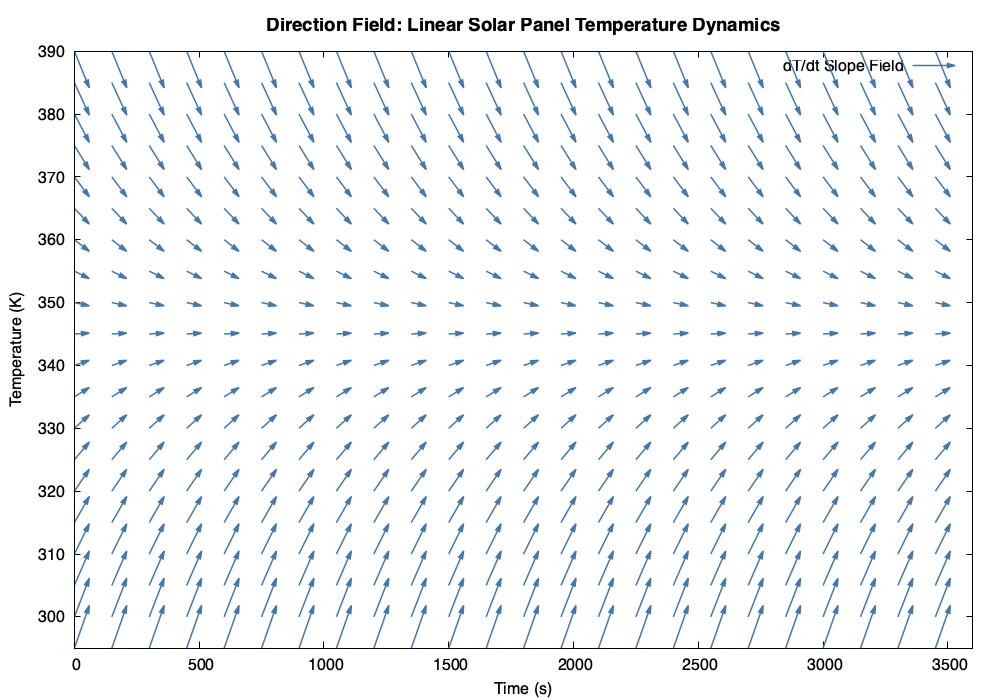
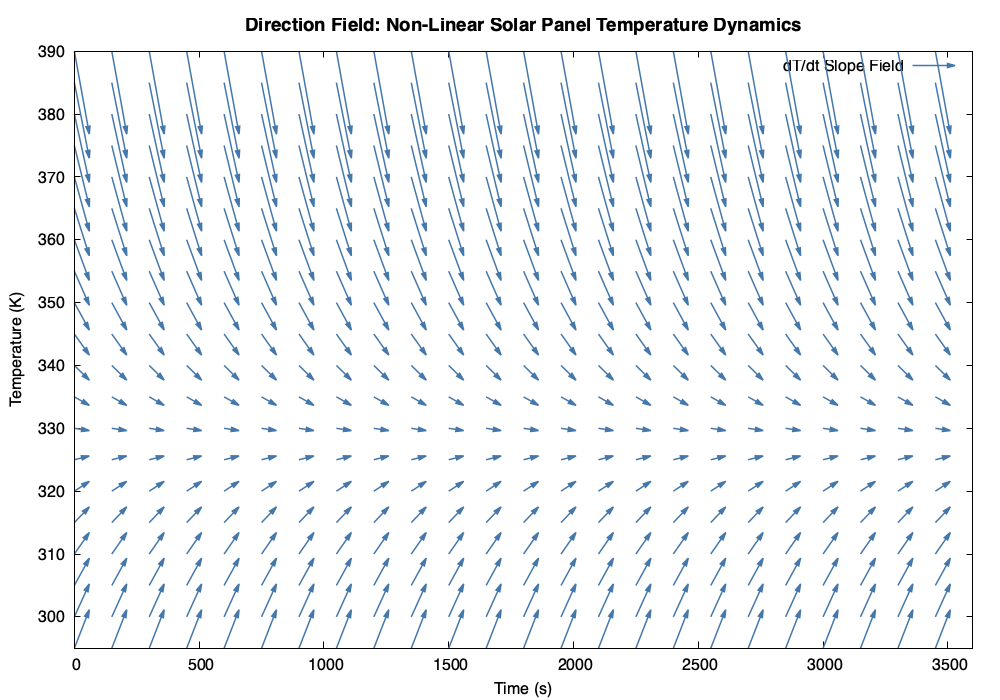
Direction Fields
Direction fields illustrate the stability of the system. Regardless of the initial temperature, the system naturally "flows" toward its steady-state temperature.
Poster and Presentation
Further details on the multi-fidelity approach and future machine learning integration can be found in the project assets below.
Future Work & Research Directions
The current implementation provides a baseline for understanding 1D thermal dynamics. To increase the predictive power and computational efficiency of the solar panel models, the following areas are identified for future development:
1. High-Order Numerical Schemes
While the Improved Euler method offers second-order accuracy, future iterations will implement Fourth-Order Runge-Kutta (RK4) and adaptive step-size solvers. These methods will allow for higher precision when modeling "stiff" equations—specifically when rapid environmental fluctuations (such as intermittent cloud cover) cause sharp gradients in the temperature derivative.
2. Multi-Fidelity Integration (AURA-MFP)
A core objective is to integrate these low-fidelity 1D ODE models into a Multi-Fidelity framework. By using the fast ODE solutions to explore large parameter spaces and reserved high-fidelity 3D simulations for verification, we can significantly reduce the computational cost of long-term environmental assessments.
3. Physics-Informed Machine Learning (PINNs)
We plan to explore the application of Physics-Informed Neural Networks to predict temperature changes. Unlike standard "black-box" models, PINNs can be trained on historical environmental data while being constrained by the underlying thermodynamic equations (convection and radiation laws), ensuring that predictions remain physically consistent.
4. Hardware Benchmarking & Cluster Computing
To support large-scale simulations, future work includes benchmarking these Fortran-based solvers on cluster architecture. This will involve optimizing the code for parallel execution across multiple nodes to handle complex multi-physics simulations involving simultaneous fluid dynamics and photon transport.